
Democracy Dies with Dictatorship
NY Times
Jul 22, 2025
Iran’s Leaders Turn to a New Brand of Nationalism After Israeli and U.S. Attacks
The theocratic government is repurposing folklore and patriotic anthems as it seeks to channel national outrage into increasing its support at home.
By Erika Solomon and Sanam Mahoozi
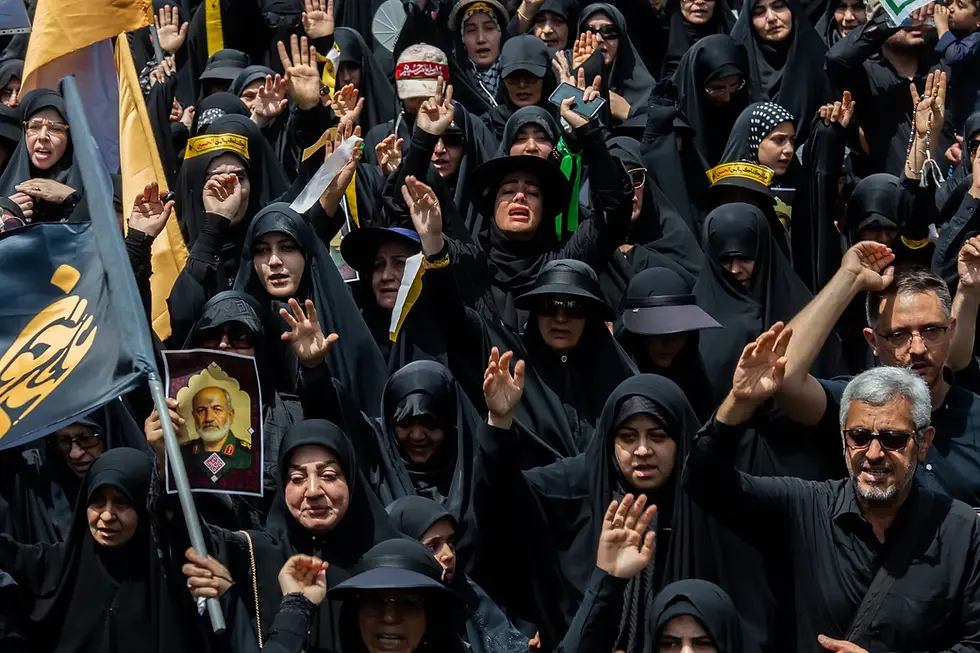
The event had all the typical trappings of Ashura, Iran’s ritualistic Shiite Muslim mourning period. The kneeling crowds were dressed in black, videos published on social media showed. They beat their chests in unison. Then, Iran’s supreme leader, Ayatollah Ali Khamenei, beckoned the man leading the chants, and whispered in his ear.
Grinning, the singer broke into a tune that would have been wildly out of place at a religious ceremony for the Islamic Republic just a few weeks ago: “Ey Iran, Iran,” a patriotic anthem.
“In my soul and spirit, you remain, O homeland,” he sang, as the crowd recited the words back to him. “Wasted be the heart that does not tremble for you.”
Iran has emerged from its war with Israel — briefly joined by the United States — deeply wounded. Its military defenses are battered, its nuclear program was pummeled and its population has been devastated by a heavy civilian toll over the 12-day war.
Amid that bleak outlook, the country’s leaders see an opportunity. Outrage over the attacks has set off an outpouring of nationalist sentiment, and they hope to channel that into a patriotic moment to shore up a government facing daunting economic and political challenges.
The result has been an embrace of ancient folklore and patriotic symbols that many of Iran’s secular nationalists once saw as their domain, not that of a conservative theocracy that often shunned Iran’s pre-Islamic revolutionary heritage.
In the ancient city of Shiraz, a billboard depicts Prime Minister Benjamin Netanyahu of Israel kneeling before a statue of Shapur I, the third-century Persian king, mimicking a frieze from the ruins of the ancient city of Persepolis.
In Tehran’s Vanak Square, a popular shopping area, a billboard has been erected for Arash the Archer, the mythological figure said to have created Iran’s borders by launching his life force from an arrowhead. Now, alongside his arrows, it is the missiles of the Islamic Republic being fired, too.

A billboard of Arash the Archer, a mythological figure, in Tehran. His arrows created Iran’s borders by launching his life force from an arrowhead. Credit...Arash Khamooshi for The New York Times
“We are witnessing the birth of a fusion of Shiite identity and Iranian nationalism — and it is the result of the attack on Iran,” said Mohsen Borhani, a law professor at Tehran University and well-known political commentator.
With no reliable polling data to offer insights on popular sentiments, the effectiveness of this patriotic craze has been hotly debated among Iranians and analysts alike.
Some Iranians are skeptical that any newfound nationalism will increase the government’s popularity, arguing that it simply reflects the widespread anger over the Israeli and U.S. attacks.
Before the Israeli attacks, some Iran analysts had anticipated domestic turmoil this summer: Alongside an economic crisis, Iran’s water, electricity and fuel supplies had been failing as temperatures soared.
The war seems to have led to an opposite effect. Now, some Iranians appear willing to stomach more government restrictions, including the tightening of internet access. The Iranian government has also begun a major crackdown against what it says are infiltrators and spies, but which rights groups say is also sweeping up dissidents and minorities.
President Trump and Mr. Netanyahu’s calls for Iranians to rise up against the government in the wake of the strikes have led even some critics of the Iranian government to argue that they could not countenance protesting right now.
“People do not want domestic change to be driven by foreign governments,” Lida, who works in Tehran, told The New York Times in a voice message. She asked not to be identified by her full name because of the government’s warnings against contact with the foreign media.
“It goes against my national pride that a country comes and violates my land and hits our nuclear sites,” she added. “OK, fine, this nuclear program is not my dream or aspiration, but in the end, it is part of my land and territory.”
This is not the first time that leaders of the Islamic Republic have leaned on nationalism or traditional symbols in times of crisis.
At the end of the Iran-Iraq war of the 1980s, historians say, Iran’s revolutionary leadership often turned to nationalist rhetoric.
But the scale and scope of the latest effort to galvanize the population are different, Iran experts say.
“The revolutionary leadership has recognized that, when the going gets tough, you have to dive deep into that nationalist rhetoric to bring people together,” said Ali Ansari, the founding director of the Institute for Iranian Studies at the University of St. Andrews. “They want to use the war as a way of encouraging national solidarity — something that they haven’t had for many years.”
That approach was especially striking as the country entered Muharram at the end of June, a period of mourning in Shiite Islam that lasts for about a month.
Ashura, marking the 10th day of that period, is when Shiites grieve for Imam Hussein, the grandson of the Prophet Muhammad.
This year, Iran’s madahs, or religious singers, brought politics into the celebrations. At shopping malls in the city of Yazd, they blended pious verses into patriotic songs that were once banned — including a religious version of an anthem penned during World War II, and often associated with the era of the Pahlavi monarchy that the Iranian revolution overthrew in 1979.
Some Iranians have not welcomed the fusion of nationalist and Islamic rhetoric, including the family of Tooraj Negahban, the lyricist who penned “Ey Iran, Iran.” The madah who recited it in front of Ayatollah Khamenei wove in religious phrases like “Iran of Karbala” and “Iran of Ashura.”
A critic of the Islamic Republic, Mr. Neghaban died in exile in Los Angeles in 2008.
“For years, you have silenced our voices. You have erased our names from books and the media,” the family wrote in a post on an Instagram page in his name. “Now that you have nothing left to shout, you are singing the same anthems you used to curse.”

Government supporters gathered this month in Tehran following Israeli airstrikes.Credit...Arash Khamooshi for The New York Times
Some Iranians, like Mr. Borhani, the Tehran University professor, argue that the theocracy’s turn to nationalism shows that religion alone can no longer galvanize Iran’s 90 million people, particularly those in their 30s or younger, who form the bulk of the population.
Others say the widespread use of patriotic tunes in Ashura rituals around the country has created an authentic new expression of Iranian patriotism.
Shahrzad, a university student in Tehran, described the shift as “engineered nationalism.”
“Authentic nationalism comes from the streets, from protests, from shared pain, not from government podiums,” she said in a voice message.
Even if the war — and the wave of nationalism it has spurred — has helped the government retain control, some question how long it will last.
“When the dust settles and people start to ask questions, they will see that there’s still no water, still no gas, still no electricity,” Mr. Ansari said. “Everything depends on the country having an economic renaissance — and it can’t do it.”