
Democracy Dies with Dictatorship
NY Times
Jun 17, 2026
Live Updates: After G7 Leaders Praise U.S.-Iran Deal, Trump Threatens Iran Again
President Trump said the United States would resume bombing Iran if he did not like the preliminary agreement, hours after leaders from the Group of 7 nations called the deal a “breakthrough.”
Jeanna Smialek reported from Évian-les-Bains, France
Here’s the latest
President Trump and other world leaders issued a joint statement praising Mr. Trump’s “strong leadership” in securing a “breakthrough” with Iran, as they gathered on Wednesday in France for the second full day of the annual Group of 7 summit.
The statement, an unexpectedly firm declaration of agreement among many of the world’s leading powers, said that the preliminary deal between the U.S. and Iran provided a “historic opportunity to prevent Iran from acquiring any nuclear weapon.”
But amid uncertainty about what the deal entails, the leaders also noted that there will need to be “a robust and comprehensive diplomatic follow-on agreement” to the memorandum that top officials from the U.S. and Iran are expected to sign in Switzerland on Friday.
“We underline the need for the negotiation to this end to address the threats posed by Iran in the region and beyond,” the statement said.
With its combination of caution and flattery directed toward the American president, the statement captured the tone of this week’s summit as it entered its final day. The gathering in Évian-les-Bains, a resort town on the shores of Lake Geneva, has been surprising so far for its cordiality, even as leaders tackle weighty and often contentious subjects.
Mr. Trump has struck a friendly tone toward European leaders whom he has a history of mocking and criticizing, even praising President Emmanuel Macron of France and speaking enthusiastically about a dinner they are set to have Wednesday night at the Palace of Versailles, the lavish estate of French royalty. They, in turn, have showered him with compliments and even gifts.
The joint statement also said that the leaders stood “united in our unwavering support” for Ukraine and pledged to “strengthen our sanctions” on the Russian economy.
Mr. Trump’s signature on such a strong statement was likely to be welcomed in Europe, particularly after he said on Tuesday the U.S. had “nothing to do” with the war in Ukraine.
Yet the discussions are still tense. The leaders from some of the world’s richest countries were set to discuss the global economy — a topic that is likely to lead to discussion of China — and the contentious question of how to regulate artificial intelligence.
Here’s what else we’re covering:
Support for Ukraine: Mr. Trump oscillated between apparent interest and indifference regarding the war. He said he planned to meet again with President Volodymyr Zelensky of Ukraine after a “very good” encounter.
A.I. regulation: Wednesday’s scheduled discussion comes after the United States barred foreigners from using Anthropic’s most advanced models, surprising many in Europe. The leading American A.I. company said the government had cited national security concerns.
Diplomatic strategies: European leaders appear to have concluded that the best way to deal with Mr. Trump is to court him. After a year dominated by rancor and the occasional sharp elbow, many turned at this week’s summit to conciliatory words and charm. Read more ›
June 17, 2026, 7:50 a.m. ET1 hour ago
Reporting from Évian-les-Bains, France
Despite concluding his remarks with an angry rant about the Obama-era Iran deal — which is looming large ahead of Friday’s signing ceremony — Trump said that it has been a “great summit.” He said his preliminary deal with Iran has been “very well received” and everybody has been “very happy.”
June 17, 2026, 7:42 a.m. ET1 hour ago
Reporting from Évian-les-Bains, France
Trump also denied that the memorandum of understanding contained “immediate sanctions relief” for Iran. The president shook his head and said, “No.” When asked again, however, he said: “They have to behave well.”
June 17, 2026, 7:31 a.m. ET2 hours ago
Reporting from Évian-les-Bains, France
Trump continued to deny that the preliminary deal included a $300 billion reconstruction fund for Iran, which reportedly would be paid by the Gulf States, but he indicated that he wouldn’t block such a provision. “It’s false,” Trump said. “You can invest if you want. What am I going to do, say no one is ever allowed to invest? We’re not investing, we’re not putting up 10 cents and people can decide to do it. That’s up to them.”
June 17, 2026, 7:17 a.m. ET2 hours ago
Reporting from Évian-les-Bains, France
President Trump, after praising the deal he just negotiated with Iran, indicated that the memorandum of understanding was not final, and if he was unhappy with how it was executed, he would resume bombings. “If I don’t like it, if they don’t behave, we’ll go right back to dropping bombs right smack in the middle of their head,” he said.
June 17, 2026, 7:14 a.m. ET2 hours ago
Reporting from Évian-les-Bains, France
Trump became incensed when talking about former President Barack Obama’s Iran deal, which he has been fixated on proving is weaker than his deal since before it was announced. During his remarks, he went on a rant repeating his claim that Obama gave Iran “$1.7 billion in cash, green cash from banks” and then used an expletive to deride his predecessor.
June 17, 2026, 7:00 a.m. ET2 hours ago
Reporting from Évian-les-Bains, France
President Trump, speaking to reporters before meeting with President Abdel Fattah el-Sisi of Egypt during the last day of the G7 summit, just made two striking admissions about the yet-to-be released deal with Iran. One, that no one knows what it entails, and that his barometer of its success is the stock market. “It’s a very strong deal,” he said. “Nobody knows what it is, but it’s very strong. Most people seem to be very happy.” He added: “Who’s really happy is the market,” and that “there’s nothing so smart as the market.”
June 17, 2026, 6:13 a.m. ET3 hours ago
Mark Rutte, the NATO secretary general, welcomed the deal that President Trump made with Iran, saying that “the U.S. action to prevent the threat of a nuclear-armed Iran, and degrade its ballistic missile capability, improves security for us all.” The deal, he said carefully, “has created an opportunity to ensure Iran never obtains a nuclear weapon.” Speaking in Brussels, he said that allies in NATO, led by Britain and France, are “ready to support” free passage of ships through the Strait of Hormuz, which “will be a massive step forward.”
June 17, 2026, 4:58 a.m. ET4 hours ago
Reporting from Évian-les-Bains, France
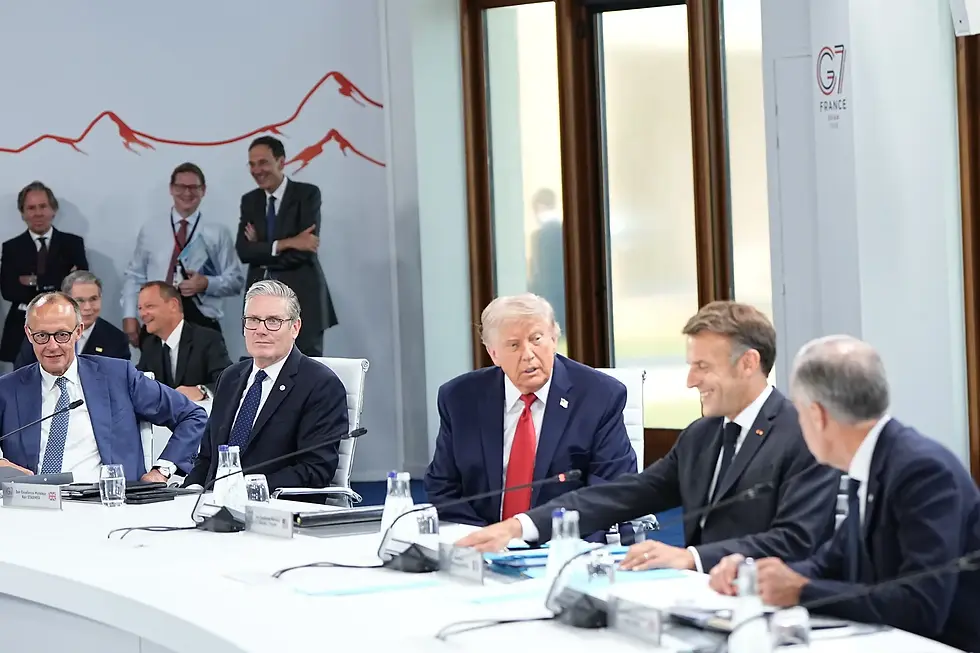
President Trump arrived at the first G7 working session of the day nearly an hour late, and upon entering the room complained that it was “too hot,” according to our correspondent, Zolan Kanno-Youngs, who is traveling with the president today. He also stood at the head of the table as he walked to his seat and said in jest, “I’m the boss.”
The meeting is not open to the press, which Trump jokingly goaded the host country about. As he sat down, he said to cameras that were briefly allowed in: “Would you like to stay for the meeting? It’s OK with me.” But the French promptly escorted press out.
June 17, 2026, 4:30 a.m. ET5 hours ago
Reporting from Évian-les-Bains, France
World leaders are slowly arriving at the working session that was scheduled to start more than 30 minutes ago. Many of the leaders are huddling together before the start of meeting.
President Luiz Inácio Lula da Silva of Brazil could be heard on a hot mic chatting with Chancellor Friedrich Merz of Germany about election systems in Brazil and his own political record. Prime Minister Keir Starmer of Britain greeted Prime Minister Narendra Modi of India and appeared to tell him the leaders had a “record of delivering.” Prime Minister Giorgia Meloni of Italy could be seen huddling with Prime Minister Sanae Takaichi of Japan. President Trump has not yet arrived.
June 17, 2026, 4:22 a.m. ET5 hours ago
Reporting from Évian-les-Bains, France
When it comes to Ukraine, the leaders’ statement pledges ”unwavering support.” It was unclear whether such a geopolitical statement could be agreed upon, so this marks something of a coup for European leaders. The fact that the U.S. signed onto a document with such a robust support for Ukraine is likely to be greeted as a huge win here in Évian-les-Bains.
June 17, 2026, 4:15 a.m. ET5 hours ago
Reporting from Évian-les-Bains, France
The G7 leaders have released a joint statement calling the announcement of a preliminary deal between the United States and Iran a “breakthrough” secured under the “strong leadership of President Trump.” It also states that a French- and British-led initiative can help to open the Strait of Hormuz for maritime traffic. Still, there’s a hint that there’s more work to be done: When it comes to the deal text, the statement says that leaders support a “follow-on” agreement and underscore “the need for the negotiation.”
June 16, 2026, 3:07 p.m. ETJune 16, 2026
Reporting from Évian-les-Bains, France
European leaders played nice with Trump on Tuesday.
When Chancellor Friedrich Merz of Germany presented President Trump with a soccer jersey emblazoned with the number 47 on Tuesday morning, it was the kind of gesture that a foreign leader might have made during his first term: flattering, emollient, and calculated to please.
But Mr. Merz was doing it after a rancorous stretch, in which he and other European leaders condemned the war in Iran, provoking Mr. Trump to announce that the United States would pull some American troops from the Continent.
Europe’s alliance with the United States may still be on the rocks, but on the first full day of a Group of 7 summit meeting at this Alpine spa town in France, the leaders showed they remained ready to behave politely toward Mr. Trump.
For all the sharp elbows of the last year, they appear to have concluded that the best way to deal with a disruptive president is to court him, particularly since they still hope to engage the United States on thorny issues like the war in Ukraine.
“We’re on the same team,” Mr. Merz said of the president on social media, wishing him a belated happy 80th birthday.
Such conciliatory words would have seemed improbable even a week ago, given the bitter split over Iran, Mr. Trump’s threats to take over Greenland and his regular hectoring of Europe’s centrist leaders — all of which persuaded several of them that America was no longer an ally, and was even, in some cases, a threat.
Now, though, Mr. Trump has presented at least the contours of a peace deal with Iran, and Europe’s leaders have gone back to charming him.
“That’s how diplomacy delivers,” said Ursula von der Leyen, the president of the European Commission, congratulating Mr. Trump on the framework. She said it would reopen the Strait of Hormuz, drive down oil prices and perhaps even ultimately put an end to Iran’s nuclear ambitions.
At one level, the bonhomie was scarcely a surprise. Even in the absence of a peace accord, analysts and diplomats predicted that the other six leaders in the Group of 7, representing the world’s advanced industrial countries, would work to prevent the meeting from collapsing in acrimony.
“Europeans in private now broadly accept that they can’t wait out Trump and that something quite fundamental in the trans-Atlantic relationship has changed,” said Jeremy Shapiro, a director at the European Council on Foreign Relations, a research group with offices in Berlin and London.
“But of course the rupture does not give Europeans an alternative plan,” Mr. Shapiro said. “So, they have to play nice with Trump.”
The president also shook up the calculus by announcing his peace agreement on the eve of the gathering. If the United States and Iran were to conclude a definitive deal — a major if, given all the uncertainties — it would be an economic lift to European economies that have been choked by the disruption to oil and gas shipments.
The three months of hostilities between the United States and Iran have put Europe’s leaders in a nearly impossible position. They have been caught between Mr. Trump, who castigated them for failing to support the effort even as he demeaned their potential contributions, and their own populations, which are mostly opposed to the war and increasingly frustrated by the economic fallout from it.
President Emmanuel Macron of France and Prime Minister Keir Starmer of Britain pledged this week to quickly deploy military assets to help ships navigate the Strait of Hormuz once it was clear the new cease-fire would hold.
“We do want to make sure that where we’ve got capability — and demining is an obvious example — where we’re coordinating that we agree a way forward with the United States and others to get the Strait of Hormuz open as soon as possible,” Mr. Starmer said.
Mr. Macron, the host of the meeting, set the tone for catering to Mr. Trump, inviting him to dinner at Versailles, the palace of France’s kings, on Wednesday to celebrate the 250th anniversary of American independence.
It was a page out of the playbook he used during Mr. Trump’s first term, when he invited him to watch a military parade on the Champs-Élysées, a grand boulevard in central Paris. And the strategy worked again, with Mr. Trump — who has a well-advertised interest in buildings laden with gold — marveling at Versailles’s gilt-edged décor.
“I was leaving in the afternoon and then the French president, who happens to be a very nice man, invited me to dinner at Versailles,” Mr. Trump told reporters. “Versailles is not a gold leaf. Versailles is the real deal.”
However polite the exchanges between Mr. Trump and Europeans, there was little evidence they had changed the president’s views about getting involved in a settlement to end the war in Ukraine.
Speaking to reporters, he reiterated his position that it is not America’s fight. “We have nothing to do with it, we sell weapons to them,” Mr. Trump said. “It has no impact on us, other than we sell weapons. We’re thousands of miles away.”
There were more subtle signs that the personal rapport between Mr. Trump and European leaders had frayed. Mr. Trump did not hold a one-on-one meeting with Mr. Starmer, forcing the British prime minister to insist that he had not been snubbed.
Mr. Trump did meet one on one with the leaders of the United Arab Emirates and Qatar — Sheikh Mohamed bin Zayed Al Nahyan and Sheikh Tamim bin Hamad Al Thani — thanking them for their support on the Iran war, with a warmth that seemed absent from his encounters with the Europeans.
When Sheikh Mohamed offered barely audible thanks back to Mr. Trump, the president joked that only a man of the Emirati’s wealth could afford to speak in such a quiet voice, and command a room. He praised Sheikh Tamim for bravery and for Qatar’s billions of dollars of investment in the United States.
Mr. Trump spent much of the day defending his agreement with Iran, the details of which he has not yet released. He dismissed reports that the United States had agreed to invest $300 billion in Iran. “We are not investing any money,” Mr. Trump said. “We have no obligation to invest any money in Iran.”
The president added that the deal includes a pledge that Iran will never have a nuclear weapon — something it has long said publicly — and warned that the country would suffer “unbelievable consequences” if it pursued one.
“That’s the reason I got in,” Mr. Trump said, “and that’s the reason I agreed to sign.”
Reporting was contributed by Erica L. Green, Zolan Kanno-Youngs and Jeanna Smialek.