
Democracy Dies with Dictatorship
NY Times
Jul 12, 2026
Live Updates: Iran Targets Gulf States After Night of Intense U.S. Strikes
U.S. Central Command said it had hit about 140 targets in Iran overnight after Tehran attacked a ship in the Strait of Hormuz. Iran’s military said it had responded by firing at U.S. targets in Jordan, Oman and Qatar.
by Leo SandsSanam Mahoozi and Aaron Boxerman
Here’s the latest.
Iran fired at U.S. allies in the Persian Gulf on Sunday after the United States conducted its most intense round of strikes against Iran in recent days, with no signs of diplomatic progress to try to salvage a cease-fire that has been steadily unraveling.
U.S. Central Command said that the Iranian navy had attacked a Cypriot-flagged container ship in the Strait of Hormuz on Saturday, and that in response, it had hit about 140 Iranian military targets, the heaviest U.S. bombardment in nearly a week of back-and-forth attacks.
Iran confirmed that it had struck what it called a “violating” vessel in the strait, and said that in response to the U.S. strikes overnight beginning late Saturday, it had targeted American military assets in Jordan, Oman and Qatar. Kuwait also reported incoming fire, and on Sunday morning the United Arab Emirates’ defense ministry said that it was also intercepting missile and drone attacks from Iran.
Iran and the United States appear locked in a spiraling cycle of attacks, at the center of which is a tug of war over control of shipping through the Strait of Hormuz, a strategic waterway used to transport a large share of the world’s energy resources.
Iran has insisted that all ships transiting the strait must travel through its territorial waters, as it seeks to use control over the waterway as leverage in peace talks. Washington has demanded that Tehran abandon its claim and say that all channels for crossing the strait are open. Neither side is backing down, putting their temporary truce in peril.
American officials had expressed optimism as recently as Friday that the strait could soon be reopened in full, but there was no sign of movement over the weekend toward a diplomatic breakthrough.
Here’s what else to know:
Latest strikes: Iran’s state broadcaster reported early Sunday that explosions had been heard in southern coastal cities that had been targeted in previous rounds of U.S. strikes, many of which include major energy centers and military installations. It said that a military barracks in Bushehr and a military site in Deyr had been among those targeted, but did not say whether there had been casualties. The U.S. Central Command did not immediately respond to a request for comment on the overnight strikes.
Trading threats: President Trump and Iran’s supreme leader, Mojtaba Khamenei, exchanged threats throughout the week as tensions built over the Strait of Hormuz. The Iranian leader, in his first statement since a weeklong funeral for his father and predecessor, Ayatollah Ali Khamenei, vowed revenge for the his killing in the first U.S.-Israeli attacks of the war.
Market volatility: The latest attacks threaten to further unsettle energy and financial markets. Daily shipping traffic through the strait recently dropped to the lowest level in weeks, according to Kpler, a maritime data tracking firm. Brent crude oil, the international benchmark, closed the week near $76 per barrel, about 5 percent higher than prewar levels. Read more ›
July 12, 2026, 7:10 a.m. ET48 minutes ago
Where the strikes have taken place in recent days.
Even after signing a cease-fire agreement last month, Iran and the United States have traded attacks over the Strait of Hormuz. The Trump administration had said the truce would reopen the waterway, which Iran has effectively blockaded since the start of the war in late February.
Iran has maintained its grip over the waterway, a vital conduit for Middle Eastern oil and gas exports. It insists all ships must pass through its territorial waters — effectively bringing them under its thumb — and fired on those which have traveled through an alternative route in the strait close to Oman.
The United States has retaliated by bombarding Iranian military installations, prompting Iran to fire barrages of missiles and drones at U.S. allies across the Middle East.
Here’s a breakdown of the attacks carried out by the United States and Iran over the past week:
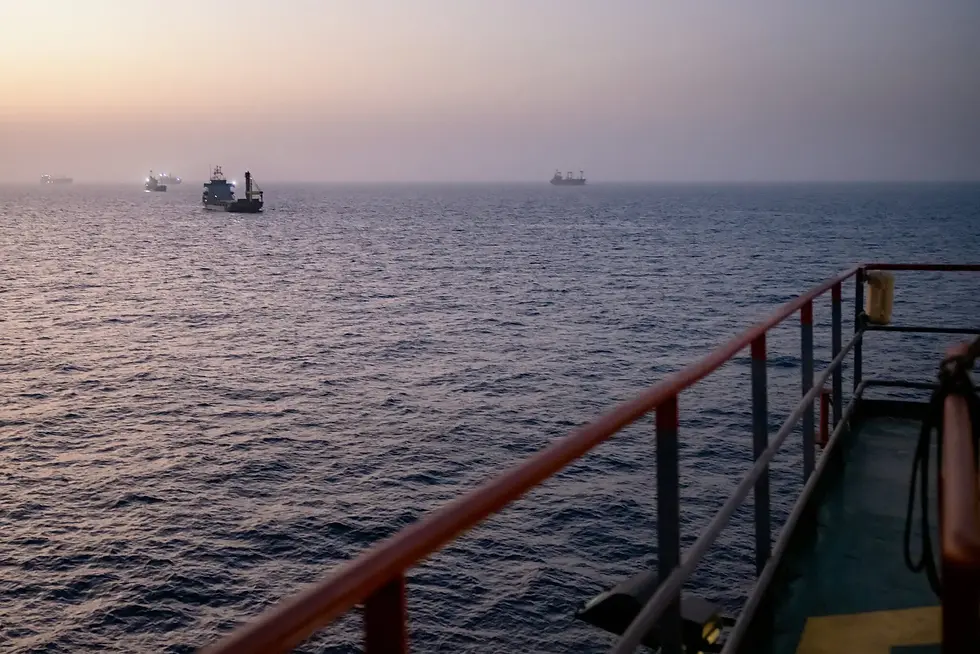
Strikes on ships: U.S. and Persian Gulf officials said Iran had attacked at least four ships over the past week, including two linked to Saudi Arabia and Qatar. The latest strike occurred on Sunday and targeted the GFS Galaxy, a Cyprus-flagged container ship transiting the strait, U.S. Central Command said. At least one Indian sailor was missing as of Sunday morning local time, according to the Indian government, after 10 others were rescued.
Strikes in Iran: The U.S. military has said it has hit about 300 targets since the heavy attacks began last week — including about 170 during a two-day barrage on Wednesday and Thursday. The attacks were aimed at degrading Iran’s ability to attack commercial ships in the strait, the military said.
In Jordan: Iran widened its attacks in the region this week to include Jordan for the first time since the cease-fire agreement was signed in June. On Sunday, the Jordanian government said three Iranian missiles had fallen in its territory, causing minor damage. Iran’s Islamic Revolutionary Guard Corps had said it was targeting the Prince Hassan Air Base, which is used by U.S. forces. That followed an attack on Muwaffaq Salti Air Base Thursday.
In Kuwait: Iranian state media said Iran’s armed forces had targeted U.S. military bases in Kuwait on Sunday. On Thursday, Kuwait faced a similar attack, saying it had intercepted three ballistic missiles, a cruise missile and 10 drones. Falling debris had injured one person and caused material damage, according to the Kuwaiti authorities.
In Oman: Iran’s Revolutionary Guards said on Sunday they had fired on a commercial port in southern Oman. The Omani government’s state-run media also reported a drone attack on sites in the country’s Musandam Peninsula, which abuts the Strait of Hormuz.
In Bahrain: Air-raid alerts went off in Bahrain on Sunday, warning of incoming fire, according the interior ministry. On Thursday, the Bahraini military said it had intercepted and destroyed several drones and missiles after Iran launched attacks.
In Qatar: Iran said that it had attacked Qatar, a key mediator in Iran’s talks with the United States. On Sunday, Qatar said it had repelled a ballistic missile attack, without providing further details.
Iranian missile and drone attacks on Gulf Arab countries have taken a significant toll, despite causing relatively limited destruction, by denting the nations’ image as safe havens for business and tourism in a turbulent region. The war has had far-reaching implications, upending these countries’ sense of security, damaging their energy-dependent economies and, in some cases, pushing them to reconsider defense strategies.
July 12, 2026, 6:04 a.m. ET2 hours ago
Reporting from Jerusalem
Persian Gulf Arab states widely condemned the Iranian attacks overnight. In a statement, Saudi Arabia’s foreign ministry denounced “Iran’s continued destabilizing behavior that undermines the security and stability of the region.” Qatar, which has been mediating between Iran and the United States, called the barrage of missile and drones a “dangerous escalation” which undermined efforts to stabilize the region.
July 12, 2026, 5:30 a.m. ET2 hours ago
Reporting from Jerusalem
Oman said sites in the country’s northern Musandam Peninsula, an area along the Strait of Hormuz, were targeted by drones, in a statement carried by the state-run media. While it did not identify who was behind the attacks, they occured amid a wave of Iranian strikes targeted Persian Gulf countries following U.S. strikes on Iran overnight.
July 12, 2026, 5:25 a.m. ET3 hours ago
Iran’s hard-liners want to keep fighting the U.S.
The striking prominence of red flags — a Shiite Muslim symbol for vengeance — among the sea of mourners attending the weeklong funeral of Iran’s late supreme leader was considered a none-too-subtle statement that the country should continue the war with the United States.
That is a demand of the ultra-hard-liners in the Islamic Republic, who want to maintain its 47-year confrontation with Washington. Analysts saw the flags as a telling example of the jockeying for position amid the newly fluid politics in Iran, ever since the war launched by the United States and Israel in February ushered in political uncertainty in Tehran by decapitating the leadership.
The hard-liners “are attempting to use the atmosphere of mourning, national insecurity and opposition to negotiations to narrow the range of politically acceptable debate and to portray compromise as both strategically dangerous and morally illegitimate,” said Saeid Golkar, a professor at the University of Tennessee at Chattanooga, who studies Iran’s security forces.
In any case, prospects for a compromise dimmed last week when the United States and Iran resumed military strikes. The fighting was prompted by the unsettled question of the extent of Iranian control over vital shipping lanes through the Strait of Hormuz.
The collapse of the cease-fire jeopardized the memorandum of understanding that the two sides signed on June 17 as a blueprint for future peace talks, including the fate of Iran’s nuclear program.
Fighting resumed Saturday evening and into Sunday, with strikes by both sides. Iran announced that the strait would be completely closed indefinitely, after its navy fired warning shots that halted a merchant vessel navigating without its permission, according to a statement carried by the official IRIB state broadcaster. U.S. Central Command said it was carrying out retaliatory strikes inside Iran.
The renewed warfare further cleaved differences over the wisdom of negotiating that have been evident in Iran since the talks began.
“There is tension between those who favor the primacy of the ‘battlefield’ and those the one of ‘diplomacy,’” said Ali Fathollah-Nejad, director of the Center for Middle East and Global Order, a think tank in Berlin. Those skeptical of diplomacy believe that Iran’s nuclear program, its ballistic missiles and its proxy forces across the Middle East are “indispensable pillars for regime survival, deterrence and power projection — and therefore nonnegotiable,” he said.
Overall, the death of the supreme leader, Ayatollah Ali Khamenei, at the start of the war is believed to have strengthened the hand of the Islamic Revolutionary Guards Corps in running the country. The absence of his son and successor in public has helped feed the air of uncertainty.
“The political atmosphere is very fluid, we don’t really know who is running the regime,” Mr. Golkar said. “The system is changing; they need time to consolidate power.”
The hard-liners are generally considered more noisy than influential, and there are plenty of proponents of negotiations among them, not least to allow Iran to fix its shattered economy.
Iran has been down a similar road before. Comparable tensions developed while the Obama administration and other world powers negotiated a landmark international nuclear agreement signed in 2015.
At that time, factional rivalries pitted reformists who sought internal change and pragmatic diplomacy against conservatives who were bent on driving the United States out of the region.
Then, in 2018, President Trump pulled out of that nuclear deal. The reformists were pilloried for being duped by Washington into limiting the nuclear program, paving the way for conservatives to consolidate control of the government.
“The ruling elite continues to be dominated by various shades of hard-liners,” Mr. Fathollah-Nejad said.
None tolerate internal dissent, but one camp describes itself as pragmatic, arguing that survival requires ending hostilities with the United States and opening the economy. The other, a minority of hard-liners, rejects any concessions to Washington, including those related to Iran’s nuclear program, and believes Iran can prevail by prolonging the war.
The dominance of the military has reduced the influence of political factions, analysts said, since security establishment priorities now take precedence. For the moment, the establishment has favored negotiation. Mohammad Bagher Ghalibaf, the speaker of Parliament and lead negotiator, is a former Revolutionary Guards commander who fiercely criticized the negotiations over the 2015 nuclear agreement.
Even if wider military control of the government limits factional machinations over policy, the leadership still must take into account the outlook of the hard-liners’ social base. Hard-line regime supporters are generally estimated at up to 20 percent of the 93 million population. They were undoubtedly the core of the mourners at the weeklong funeral that ended Thursday.
Ayatollah Mojtaba Khamenei, who succeeded his father as supreme leader, joined the calls for vengeance. “We pledge that we will avenge your pure blood and the blood of all those martyred in these two wars from the criminal and disgraced killers,” he said in a rare statement issued on Saturday. “This revenge is the demand of our nation, and it must certainly be carried out.”
The younger Mr. Khamenei did not attend his father’s funeral and has not been seen in public since he was reportedly gravely wounded in the initial attack on Iran on Feb. 28. He had earlier released an ambiguous statement assenting to the memorandum of understanding, but disagreeing with signing it “as a matter of principle.”
That ambiguity gave extremists a window to try to influence policy, analysts said, which prompted a concerted effort, leading to the red flags at the funeral. Many were emblazoned with an Arabic phrase that means “O Vengeance for Hussein.” The death of Imam Hussein in A.D. 680 at the hands of a tyrant is a significant Shiite symbol for avenging innocent blood and resisting tyranny.
“Hard-liners believe that the Islamic Republic should explicitly threaten to personally avenge the assassination of its leader and senior officials, not merely as a bargaining strategy but also as a means of deterring future attacks,” said Mohammad Tabaar, a professor at Texas A&M University who specializes in Iranian politics. “We now see this idea gradually being adopted by the leadership, as reflected in the prominent use of red symbolism during Khamenei’s funeral.”
Hossein Shariatmadari, the influential editor of the Kayhan newspaper, whose columns often reflect hard-line thinking, questioned why negotiators had accepted allowing any shipping through the strait. “You know for sure,” he wrote, “that opening the Strait of Hormuz is tantamount to disarming Islamic Iran in the face of enemy attacks?!”
In an even more explicit demand, he wrote a front-page editorial last week titled “We Want Trump’s Head,” which demanded that the government declare the U.S. president a legitimate target and offer a hefty reward for his killing. Several other conservative or extremist dailies published similar front-page threats against Mr. Trump. Aside from the killing of the supreme leader, hard-liners hold Mr. Trump responsible for authorizing the assassination of Qassim Suleimani, an important I.R.G.C. commander, in Baghdad in 2020.
The regime has long used crowd size as a mark of its legitimacy, so the millions of mourners in Iran and Iraq were cited as evidence that the government in Tehran enjoyed both domestic and regional support. Yet economic problems set off widespread demonstrations in Iran earlier this year that were put down with extreme violence, with many government critics disappointed that the war did not bring regime change.
Still, the government has to tread carefully when it comes to public perceptions of the negotiations.
“They have to think about the regime’s social base,” said Mr. Golkar, the University of Tennessee professor. “That is the core that has kept the regime in power for the last four decades. Every time there is a crisis, they come out. They cannot throw them under the bus.”
The government might ultimately jettison its anti-American ideology should the benefits prove worthwhile, analysts said. “If they see a deal beneficial to them and credible in terms of the U.S. delivering its end of the bargain, they would absolutely welcome it because it could increase their own constituency in Iran,” said Mr. Tabaar, the Texas A&M professor. “It could appeal to a lot of Iranians who want to have better relations with the U.S.”
At present, strong doubts persist about the United States upholding any bargain. Given the history, analysts said, there is widespread suspicion that Mr. Trump, although he wants a deal to help reduce oil prices, will eventually renege on it.
Those negotiating are careful to keep their distance to avoid looking like chumps if the United States tears up yet another agreement. Mr. Trump was quick to call the memorandum “over” during recent flare-ups.
Soon after the negotiations began, Esmail Baghaei, the Iranian foreign ministry spokesman, was asked why the Iranian delegation had refused to shake hands publicly with their U.S. counterparts. He quoted the poet Rumi: “Since there are many devils with human faces, one should not give one’s hand to every hand.”
Shirin Hakim and Rozhin Rajavi contributed reporting.
July 12, 2026, 5:08 a.m. ET3 hours ago
Reporting from Jerusalem
The Indian government condemned the attack on a commercial vessel off the coast of Oman overnight, saying that one Indian national who was on board was missing and 10 others had been rescued. U.S. officials blamed the attack on Iran, although India did not identify the perpetrator.
July 12, 2026, 3:04 a.m. ET5 hours ago
Jordan’s communications ministry said on social media that three Iranian missiles had fallen within its territory on Sunday morning, causing minor material damage and no casualties. It did not mention the Prince Hassan Air Base, which is used by U.S. forces, and where Iran’s Islamic Revolutionary Guard Corps had earlier claimed to have destroyed several targets. That claim was not immediately verifiable.
July 12, 2026, 2:53 a.m. ET5 hours ago
Qatar’s interior ministry said three people, including a child, were injured by debris that fell when its forces intercepted Iranian attacks.
July 12, 2026, 1:25 a.m. ET7 hours ago
Mohammad Bagher Ghalibaf, Iran’s top negotiator in the peace talks, said on social media that the “era of one-sided deals” was over, in comments that seemed to be aimed at the United States.
“We told you: keep your word or pay the price. Reality is knocking,” he wrote, posting an image of a section of the memorandum of understanding between Iran and the United States that Tehran has insisted means it alone can decide which routes ships use in the Strait of Hormuz.
He posted his statement shortly after Iran’s Islamic Revolutionary Guard Corps said it had struck a second vessel in the waterway, without providing specifics.
July 12, 2026, 1:08 a.m. ET7 hours ago
Iran’s Islamic Revolutionary Guards Corps said in separate statements that it had struck U.S. military assets in Qatar and Oman. Neither claim could be immediately verified, and U.S. Central Command did not immediately respond to a request for comment.
The Guards Corps said in a statement carried by Iranian state media that it had destroyed targets at the Al Udeid Air Base in Qatar. In a separate statement on social media, the Guards Corps claimed it had destroyed targets in a “surprise attack” at the Port of Duqm in Oman.
July 12, 2026, 12:28 a.m. ET7 hours ago
The Kuwait Army said it was intercepting hostile aerial attacks, while Qatar’s military said it was continuing to intercept ballistic missiles. Neither country specified the origins of the attacks.