
Democracy Dies with Dictatorship
NY Times
Jun 13, 2025
Oil Prices Surge and Stock Markets Stumble After Israel Attacks Iran
The military strikes jolted investors, raising concerns that a broader Mideast conflict would disrupt the world’s energy supplies.
Israel’s military strikes against Iran shook global markets, as oil prices surged and stocks tumbled on worries that the attacks could set off a broader Mideast conflict that would disrupt the world’s energy supplies and stoke inflation.
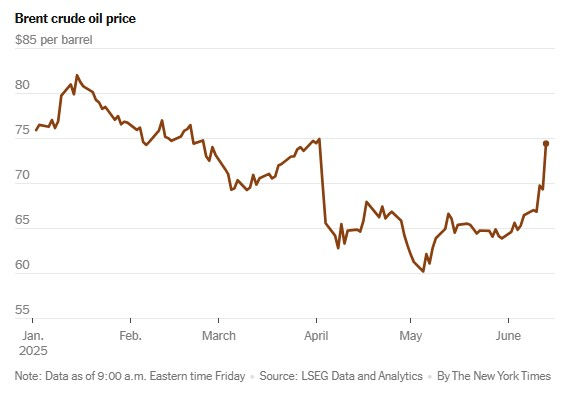
Prices of Brent crude oil, the international benchmark, jumped on Friday, rising 7 percent to above $74 a barrel. It was oil’s largest daily gain this year, and capped a choppy week of trading as investors anticipated a potential strike.
Stock markets fell broadly across Asia and Europe. The S&P 500 fell a bit less than 1 percent in early trading in New York.
Investors seeking less risky places to put their money bid up the price of gold. The yield on the 10-year U.S. Treasury note, which move inversely to prices, fluctuated, with an initial decline giving way to a small rise. Still, yields are markedly lower than they were at the start of the week.
Iran is among the world’s largest producers of oil, and it sells almost all of what it produces to China, which consumes 15 percent of global supply. Sales by Iran’s state oil company to China represent about 6 percent of Iran’s entire economy, and are equal to about half its entire government’s spending.
Iran’s exports have lagged in recent years as international sanctions have limited its ability to modernize its oil extraction and transportation technology.
But Iran’s shipments have begun to recover in the past year on strong demand from China, which would be forced buy oil elsewhere if a broader conflict were to interrupt Iranian supplies.
Iran holds a strategic position on the northern side of the Strait of Hormuz, at the exit of the Persian Gulf. That means Iran could block oil and natural gas exports from other Mideast oil producers in retaliation for the Israeli strike. About a third of the world’s seaborne oil shipments pass through the strait.
Meghan L. O’Sullivan, a former U.S. deputy national security adviser specializing in the Mideast, said the United States military had the ability to force a reopening of the Strait of Hormuz, but that could create bigger issues.
“Such action would bring America squarely into the conflict, moving it to greater levels of regional disruption and global uncertainty,” said Ms. O’Sullivan, who is the director of the Harvard Kennedy School’s Belfer Center for Science and International Affairs.
In any case, Iran has strong financial reasons not to close the Strait of Hormuz: Nearly all of its oil exports must pass through it. And much of the oil imported by China is shipped through the strait.
“If I were Iran, I would think twice before closing the Strait of Hormuz,” said Muyu Xu, senior Asia oil analyst at Kpler, a global commodities and shipping data firm. “If they choke the Strait of Hormuz, they cannot move barrels out.”
The United States in recent years has become far less dependent on oil from the Persian Gulf, because of the rise of fracking and other advanced techniques to extract oil. Europe, along with China, import large quantities of oil from the region.
Iran has long had tense relations with Saudi Arabia, which tilts toward the United States, an ally of Israel. In 2019, Iran and its proxies used drone strikes to destroy oil facilities in Saudi territory.
Saudi Arabia, the third-largest producer of oil after the United States and Russia, has a backup plan in case of a wider conflict. It has built an extensive pipeline system leading south from the coast of the Persian Gulf, where it produces most of its oil, to the Red Sea, where oil could be loaded onto tankers.
“It’s hard to see what comes next, but the oil market isn’t yet pricing in a catastrophic scenario,” which would include the disruption of oil and gas supplies through the Strait of Hormuz, said Justin Alexander, director of Khalij Economics, a research and consulting firm focused on the Gulf.
In the worst case, estimates suggest “something like a doubling of the oil price,” he added. But if only Iran’s oil and gas supplies are disrupted, then spare capacity from the OPEC Plus group of countries, already in the process of ratcheting up production, could make up the difference and limit the potential rise in prices.
Jason Karaian contributed reporting from London.
Keith Bradsher is the Beijing bureau chief for The Times. He previously served as bureau chief in Shanghai, Hong Kong and Detroit and as a Washington correspondent. He has lived and reported in mainland China through the pandemic.