
Democracy Dies with Dictatorship
IranWire
Feb 1, 2026
Stories of Love and Loss From Iran’s Deadliest Nights
On January 8 and 9, many people went out into the streets and never came back. Parents were shot and killed while holding each other’s hands. Sisters and brothers were left behind, sometimes together, sometimes alone. Children - innocent and untouched by any crime - lost their lives.
Young men and women, raised with care and love, were buried by the very parents who had once held them as babies.
Among the dead were young women who had to bury the people they loved most. The last hugs, the final kisses on cold, pale faces made one thing clear: there are no miracles left. Love cannot wake the dead.
This report is a tribute to Mahsa, Zeinab, Mahta, and Fatima.
Mahsa and Matin: They Killed Love
“Just tell me where you are, Matin. Are you okay, my soul? I am the loneliest person here, but I would sacrifice everything for a single strand of your hair - my religion and my world. Just let you be okay.”
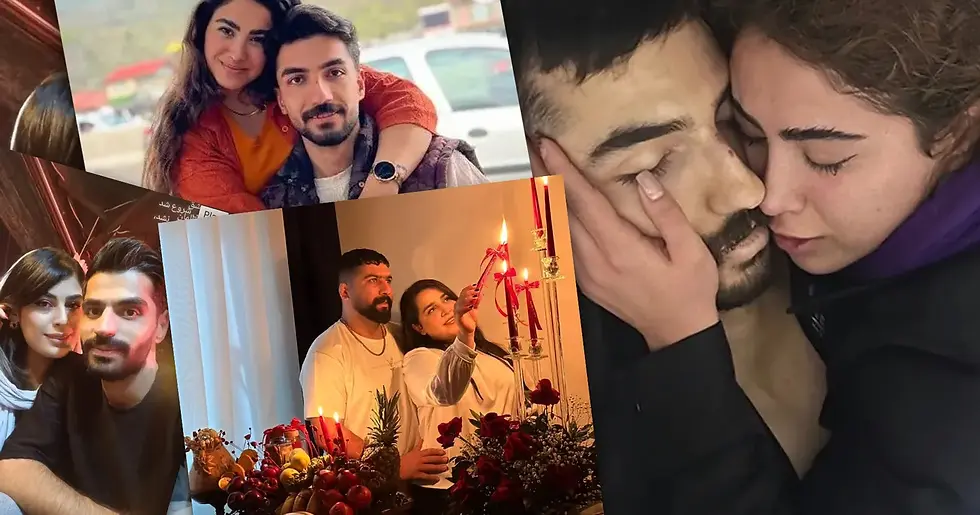
These heart-wrenching words were written by Mahsa Khanjani, a new bride. The image of her final embrace, saying goodbye to Matin Ghorbani - her husband, killed in the protests on January 8 - set many hearts on fire.
In the quote above, Mahsa uses the phrase “Dore-t begardam” (literally, “let me circle you”). This is a deep Persian term of endearment meaning the speaker would take on any misfortune meant for the loved one. In the context of the 2026 protests, it underscores the intense personal devotion of a generation facing state violence.
Matin Ghorbani was a young barista who was shot and killed by security forces during the January 8 protests in Karaj. He is buried in a corner of Imamzadeh Taher cemetery, but for Mahsa, the weight of his death sits heavy in her chest, constant and burning.
Mahsa is a photographer. Perhaps that is why she captured every moment of her life with her tall, kind lover - and now revisits those memories with deep longing and immense grief.
Karaj is a major industrial city near Tehran that saw some of the most violent crackdowns in January. Imamzadeh Taher is a historic cemetery where many prominent Iranian artists and thinkers are buried; it has now become a site of pilgrimage for those mourning the “martyrs” of the recent uprising.
Matin and Mahsa tied the knot a year ago, hopeful for the good days ahead. According to Mahsa’s Instagram posts, they “grew and matured together” during this single year. On January 25, she published a photo of their final goodbye and wrote: “I won’t forget the moment we said goodbye. You took my hand and said, ‘Take care of yourself.’”
Looking through the posts and stories of their life together is painful, even for people who never knew Mahsa and Matin. The love they shared feels alive in every image, and so does the loss. It is easy to understand how hard it is to love someone deeply and still step into the streets for dignity and freedom.
Many people who came across Mahsa’s posts have written to her, saying they wish they had never learned her name this way, through grief and irreversible loss.
Mahta and Kianoush: You Said “Don’t Fear, My Love,” and Left
“Kianoush, you told me, ‘Don’t be afraid, my love. Don’t worry. I’ll call you late tonight.’ But I searched the city for days. The lights of your house were off. I never thought they would end your headaches with a bullet to your head.”
These words were written by Mahta, a young woman who lost her partner in the January 8 protests in Shahin Shahr.
Even reading these sentences can break a person. Such a staggering experience for a generation just entering its twenties is a heavy price to pay.
Kianoush Ebad was 27 years old, a professional hairstylist in Shahin Shahr, Isfahan. Before blowing out the candles for his 27th birthday, he turned to Mahta and said: “To the hope of good days, to the hope of beautiful days, by your side.”
He was killed in the January 8 protests by a direct shot to the head from suppression forces. His body was held “hostage” for days. It took more than two weeks for it to be handed over to his family. IranWire sources in Shahin Shahr say that Kianoush was finally buried on January 27, 2026: “They release the bodies between 9 p.m. and 5 a.m., and they must be buried immediately, in silence.”
Shahin Shahr, in Isfahan province, is home to a diverse population, including many internal migrants and a large middle class. During the 2026 protests, it emerged as one of the key centers of resistance. Holding bodies for days before releasing them - a practice often described as taking them “hostage” - is a method the authorities use to stop public funerals, which frequently turn into new protests.
In one of her videos from their happy days, Mahta wrote that they had already chosen their clothes and flower bouquets to begin their life together on January 31. That dream was left unfulfilled. Now, instead of sending out the address of a wedding hall, she sends Kianoush’s eternal home to his friends: “Come to Behesht-e Masoumeh, Section 20, Row 3.”
Fatima and Mohammad-Reza: The Bullet That Struck Love’s Forehead
“Since you left, everything has changed. They took you from me in a war, without me being ready, without me knowing it was the last day. A single piece of news came, and a world collapsed. Every day I wake up thinking you should still be here, that you should still message me, that you should still return. But it’s not possible.”
These are the words of Fatima, a young woman who has committed her brave young love to the earth.
Mohammad-Reza Mohseni was 23 years old - a resident of Tehran, an athlete, vibrant and selfless. On January 8, when waves of people took to the streets in Moshiriyeh, Afsariyeh, and Kianshahr, Mohammad-Reza was among them. When the internet was cut, suppression agents opened fire on the crowd.
One of the stray bullets struck Mohammad-Reza in the forehead, taking his life.
These are working-class neighborhoods in southeast Tehran. Cutting off the internet is a familiar tactic used to conceal the scale of violence. Once people lose access to the outside world, the streets become far more dangerous.
Fatima, like many young women who have lost their love, is restless. Telling her to “be strong” or “be proud of him” does not cool the fire in her heart. She says, “I am left with a void that nothing can fill. My heart is heavy. I’m tired of this damn world. It wasn’t supposed to end like this.” On January 22, he was buried in Section 218, Row 500 of Behesht-e Zahra cemetery in Tehran.
Zeinab and Ali-Asghar: You Didn’t Stay
Only 34 weeks have passed since Zeinab posted a happy photo of the two of them with the caption: “And your body is my homeland.” Now, her life partner has become a sacrifice for the actual homeland.
Ali-Asghar Mohammadi, a 34-year-old Gilak citizen from Chamestan, was killed by direct fire from government forces on January 9.
The videos Zeinab shares are hard to watch. In one, she holds the lifeless body of the man she loved, wrapped in a black shroud, inside a room that once held their everyday life. She knows he can no longer feel pain, but she still touches his injured cheek and forehead, gently wiping the blood from his nose with a white cloth.
In the next frame, in the darkness of night, she lies down on the cold earth that has taken the tall frame of her partner. A black cloth is draped over the grave. Zeinab strokes the fabric and whispers, “But I still haven’t believed your passing.”
Ali-Asghar’s death highlights how the uprising has unified different ethnic groups - Gilaks, Kurds, Persians, and others - under a shared grief. The image of Zeinab lying on the grave is a powerful Persian expression of mourning, signifying a refusal to leave the loved one alone in the coldness of death.
IranWire continues to receive the names of those killed on January 8 and 9, day after day. Our effort is to record and narrate their names and life stories. These four young women are not alone in their grief, but their stories reflect the loss shared by thousands of families whose lives and futures were shattered by the violence of the Islamic Republic.