
Democracy Dies with Dictatorship
The Independent
Jan 30, 2026
Trump-Iran latest: US president warns Tehran must do ‘two things’ to avoid military force
Tehran warned that it will retaliate instantly and decisively to any US attack
by Alisha Rahaman Sarkar & Alex Croft
Donald Trump has warned Iran it must do “two things” to avoid US military action, as US forces continue to build in the Middle East.
"Number one, no nuclear. And number two, stop killing protesters," the US president said, adding that there are “lot of very big, very powerful ships sailing to Iran right now”.
Tensions continue to simmer between Washington and Tehran, sparking concerns that Trump will decide to renew the conflict between the US and Iran followint tit-for-tat strikes last summer.
Iran earlier warned it will retaliate to any US attack “instantly” and that its response would not be limited. A response would likely see it attack the US military bases stationed in Gulf countries.
Iranian brigadier general Mohammad Akraminia said the bases are “within the range of our medium-range missiles”.
He added: "If such a miscalculation is made by the Americans, it will certainly not unfold the way Trump imagines – carrying out a quick operation and then, two hours later, tweeting that the operation is over.”
Trump earlier said he plans to speak with Iran but did not elaborate on the nature or timing of the dialogue.
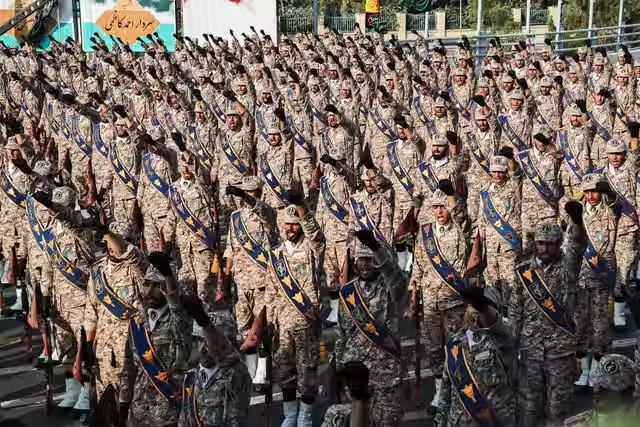
How powerful are Iran's Revolutionary Guards?
As we reported earlier, the EU has agreed to designate Iran’s Revolutionary Guards (IRGC) as a terrorist organisation, which she said will put the regime "on the same footing" with al-Qaida, Hamas and the Islamic State group.
The group is often touted as one of the most powerful forces in the Middle East - but how powerful are they really?
Unlike the ordinary military, which comes under the Defence Ministry in the elected government, the IRGC answers directly to the supreme leader, Ayatollah Ali Khamenei.
Formed soon after the revolution, the IRGC's role defending the Islamic system greatly expanded during the 1980-88 war with Iraq and it is now the strongest and best-equipped section of Iran's armed forces.
Over the decades, the Guards have extended their influence through the worlds of politics and business, gaining in power at home and abroad.
The Quds Force, an elite Guards unit, has spearheaded Iran's regional strategy of supporting affiliated Shi'ite groups across the Middle East, most notably in Lebanon and Iraq. That strategy was hard-hit by the U.S. assassination of Quds Force commander Qassem Soleimani in a 2020 air strike in Iraq, and by Israel's pummelling of Lebanon's Hezbollah in a 2024 war.
The Basij militia, a part-time paramilitary force under Guards control, is often used to quell protests inside Iran.
Since the early 2000s, the Guards' economic power has grown as its contracting company Khatam al-Anbiya won projects worth billions of dollars in Iran's oil and gas sector.
Starmer: ‘We need to deal with Iran’
The Independent’s political correspondent Athena Stavrou reports:
Sir Keir Starmer has said the UK and its allies need to “deal with” Iran amid its ongoing deadly crackdown on protesters.
On his visit to China, Sir Keir said the repression of demonstrators was “grotesque” and “that is where our focus is”.
US President Donald Trump has ramped up pressure on the country in recent days, warning that time is running out to agree a deal on its nuclear programme and called for an end to the “senseless killing”.
The UK prime minister also said the UK supports “the goal” of preventing Iran from developing a nuclear weapon, but stopped short of explicitly backing US military action in the region.
“The goal or the aim here is that Iran shouldn’t be able to develop nuclear weapons and that is hugely important and, of course, we need to deal with the fact they are repressing protesters, killing protesters,” he told the BBC.
“It is grotesque what is happening so that is where our focus is and we are working with allies to that end.”
Pressed on whether Britain would support another US strike on the country, he said: “I am saying we support the goal and we are talking to allies about how we get to that goal.”
Full report: US plane dubbed the ‘nuke sniffer’ lands in UK amid growing tensions with Iran
A US Air Force plane has landed at an American airbase in Britain, as tensions continue to escalate with the Iranian regime.
Dubbed the “nuke sniffer”, the USAF WC-135R Constant Phoenix jet is used to detect radioactive particles in the atmosphere and was reportedly deployed to the Middle East days before Donald Trump bombed Iran’s nuclear facilities last year.
While the reason for its latest trip to RAF Mildenhall in Suffolk is unclear, defence sources told The Telegraph that its presence did not indicate that military action was imminent.
Speculation is continuing to grow that Washington is considering a strike on Iran, with the US president warning that a “massive armada” had been dispatched to the Middle East, as part of a build-up of American forces in the region.
US president Donald Trump has warned ‘massive armada’ of American forces building up in the Middle East
Oil slips, but set for biggest monthly gain in years
Oil prices slipped more than 1 per cent this morning from multi-month highs, though they are set for their most substantial gains in years, as the risk premium surged due to a potential US attack on Iran that could disrupt supplies.
Brent crude futures fell 91 cents to $69.80 a barrel after rising 3.4 per cent to close at its highest point since 31 July yesterday.
The March contract expires later today. The more active April contract slid $1.07 to $68.52.
US West Texas Intermediate crude dropped $1.06 to $64.36 a barrel after gaining 3.4 per cent to settle at its highest level since 26 September in the previous session.
Iran to designate EU armed forces as terrorists in retaliatory measure
Iran plans to designate the armed forces of EU countries that have blacklisted the Islamic Revolutionary Guard Corps as "terrorists", according to top Iranian security official Ali Larijani on X.
It would be a direct response to the EU’s earlier announced that it had agreed to designate the IRGC as a terrorist group, a move foreign policy chief Kaja Kallas said would put it "on the same footing" with al-Qaida, Hamas and the Islamic State group.
"Therefore, the consequences will fall on the European countries that undertook such an action," Larijani said.
Iran open for talks with US but they must be 'fair and equitable', says foreign minister
We’ve got more lines for you from the press conference between Iranian foreign minister Abbas Araghchi and his Turkish counterpart, Hakan Fidan.
Iran is prepared for the resumption of talks with the United States, but negotiations should be "fair and equitable", Mr Araghchi said.
Araghchi, who described his talks with Hakan Fidan in Istanbul as "good and useful", also said that Tehran was ready to engage with regional countries to promote stability and peace.
Mr Fidan, meanwhile, said he had spoken with US special envoy Steve Witkoff on Thursday and that he will continue speaking to US officials on Iran.
He said he hoped a solution could be found to avoid conflict and the isolation of Iran.
Starmer: UK working with allies to ensure Iran does not develop nuclear weapons
Sir Keir Starmer said the UK was working with allies to ensure Iran does not develop nuclear weapons after Donald Trump deployed a naval armada and warned time is running out for Tehran to do a deal.
The prime minister said: “Well, the big issue, the big challenge here, is to ensure that Iran doesn’t get a nuclear programme and we all absolutely agree on that, and we’re working with allies to that end, and that is the central focus I’m doing with our allies.”
Asked if Mr Trump’s actions were right, Sir Keir said: “We all agree that ensuring that Iran doesn’t get that nuclear programme is is the number one priority, and that’s what we’re working on.”
Where did Iran's Revolutionary Guards originate from?
The Guard rose out of Iran’s 1979 Islamic Revolution as a force meant to protect the country's Shiite cleric-overseen government and later became enshrined in its constitution. It operated parallel to Iran's regular armed forces, growing in prominence and power during a long and ruinous war with Iraq in the 1980s.
Though it faced possible disbandment after the war, supreme leader Ayatollah Ali Khamenei granted it powers to expand into private enterprise, allowing the force to thrive and become a huge force in both Iran’s security and economic infrastructure.
The Guard runs a massive construction company called Khatam al-Anbia and has firms that also build roads, man ports, run telecommunication networks and even offer laser eye surgery.
US and Iran must resume nuclear talks, says Turkish foreign minister
We’re hearing more from the press conference involving Turkish foreign minister Hakan Fidan and his Iranian counterpart Abbas Araghchi.
Fidan calls on the United States and Iran to come to the negotiating table to resolve issues between them, reiterating that Ankara opposes foreign intervention in Iran.
He says that it’s critical for US-Iran talks on Tehran’s nuclear programme to restart to ease regional tensions.