
Democracy Dies with Dictatorship
NY Times
Apr 4, 2026
What We Know About the Jets That Crashed and the Search for a U.S. Airman
An F-15E Strike Eagle was shot down over Iran and an A-10 Warthog crashed near the Strait of Hormuz, officials said on Friday. Two airmen were rescued, and one is unaccounted for.
ByNeil VigdorandAurelien Breeden
The U.S. military lost its first fighter jet to enemy fire from Iran on Friday, U.S. and Israeli officials said, prompting an urgent search for one of its crew, who was still missing a day later.
It was a high-profile setback for the Trump administration, which has repeatedly sought to project American air supremacy in the war.
The two crew members on the plane, an F-15E Strike Eagle, were able to eject from it, U.S. military officials said. One was rescued soon afterward, but as of early Saturday, the other had not been found.
Separately, another Air Force combat plane, an A-10 Warthog, crashed in the Persian Gulf region on Friday. The lone pilot was rescued, according to two U.S. officials who spoke on condition of anonymity to discuss operational matters.
Where was the first jet shot down?
Iran shot down the F-15E over the southwestern part of the country on Friday. Iran’s state broadcaster shared images that it claimed showed the wreckage.
The images showed the wingtip and top section of a vertical stabilizer from an F-15E, according to Justin Bronk, a senior research fellow who studies air power and technology at the Royal United Services Institute, a research institution in London. He said markings on the vertical stabilizer section were consistent with the 494th Fighter Squadron of the U.S. Air Force, based at R.A.F. Lakenheath in England.
How have rescue efforts unfolded?
An intense rescue operation played out in the skies over southwestern Iran on Friday, where videos posted to social media and verified by The New York Times showed a C-130 transport aircraft and military helicopters flying at a low altitude.
Pilots are normally equipped with a radio, and ejection seats have a beacon that can help in rescue missions. But those kinds of operations are fraught with risk.
In 2005, Taliban forces in eastern Afghanistan ambushed four U.S. Navy SEALs, prompting a rescue mission.
Sixteen U.S. service members attempting to reach the SEALs were killed when their helicopter was shot down.
During Friday’s rescue operation, a U.S. Air Force UH-60 Black Hawk helicopter was hit by Iranian ground fire but managed to fly to safety in Iraq, American and Israeli military officials said.
How have Iran and the United States reacted?
Iran’s regime has offered a reward for the capture of “enemy’s pilot or pilots,” who it said should be turned over alive to security forces, according to a local affiliate of Iran’s state broadcaster.
Karoline Leavitt, the White House press secretary, said on Friday that President Trump had been briefed about the situation, but his administration has said little beyond that. Defense Secretary Pete Hegseth and the Pentagon have not commented.
The fighter was shot down two days after Mr. Trump declared in an address to the nation that the United States was moving closer to achieving its military objectives and that it would intensely bomb Iran “over the next two to three weeks.”
What kind of jet was it?
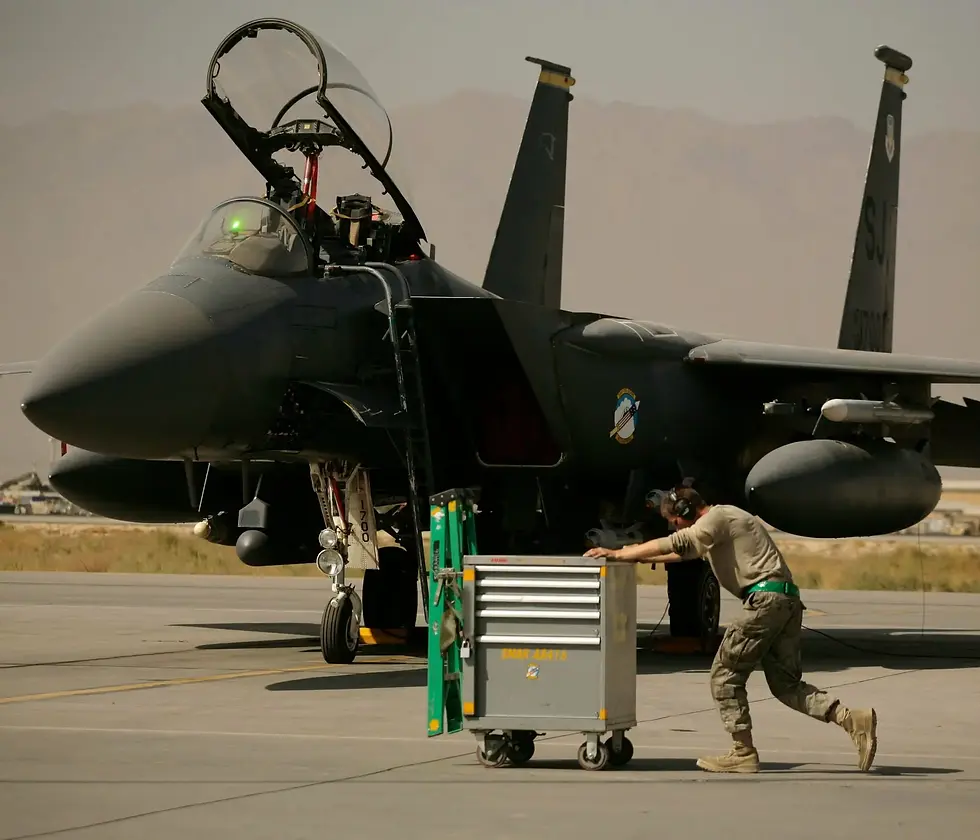
The F-15E Strike Eagle does not have the stealth capabilities of more recent generations of fighter jets. The warplane, which first flew in 1986, can be used for air-to-ground and air-to-air combat and has been deployed by the U.S. military in Iraq, Libya and Syria.
It carries a crew of two, the pilot and a weapons system officer, according to the U.S. Air Force. It can reach speeds of 1,875 miles per hour, or Mach 2.5, and carry a payload of more than 20,000 pounds.
What about the other plane that crashed?
That aircraft, an A-10 Warthog, crashed on Friday at about the same time the F-15E was shot down over Iran, according to the two U.S. officials who spoke on condition of anonymity to discuss operational matters.
The officials said it crashed near the Strait of Hormuz, the crucial oil shipping lane that Iran has been blocking, but they did not say what caused the plane to go down. The Iranian military said its air-defense systems had hit an A-10.
Two Pentagon officials said this month that it was doubling its Middle East fleet of A-10 Warthogs, a support plane with a nose-mounted cannon that can fire 70 30-millimeter shells a second. It flies at low altitudes and slow speeds, which allows it to loiter over targets on land and at sea and to support advancing ground troops.
Pranav Baskar, Ronen Bergman and Eric Schmitt contributed reporting.
Neil Vigdor covers breaking news for The Times, with a focus on politics.
Aurelien Breeden is a reporter for The Times in Paris, covering news from France.